

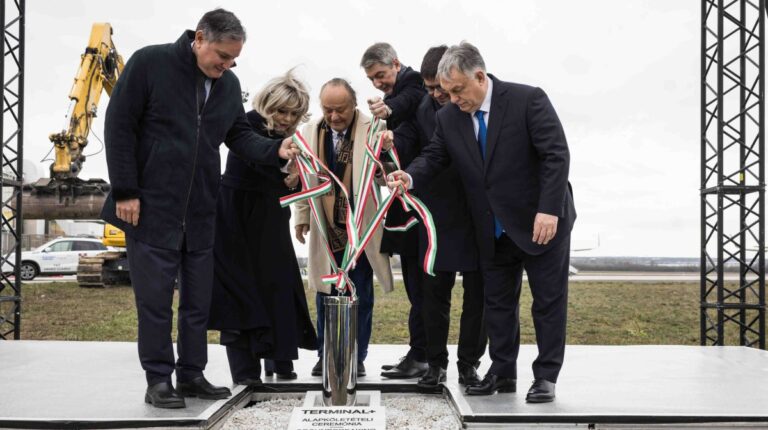
Construction of a new terminal complex has begun at Budapest Ferenc Liszt International Airport with the laying of the foundation stone to mark the start of the expansion project.
The ceremony was attended by Hungarian Prime Minister Viktor Orbán; Hungarian minister for national economy Márton Nagy; Nicolas Notebaert, president of Vinci Concessions and Vinci Airports; and François Berisot, CEO of Budapest Airport.
The development forms part of a €1bn (US$1.2bn) investment program planned for the next 10 years, aimed at expanding capacity and modernizing facilities at the Hungarian capital’s airport.
Budapest Airport handled nearly 20 million passengers in 2025, a 35% increase in traffic since Vinci Airports assumed operations following a joint investment with the Hungarian state. The expansion is intended to address growing passenger demand and to deliver an enhanced experience for travelers.
The program will include the construction of a new 35,000m² main terminal featuring centralized check-in facilities, updated security screening areas and integrated commercial spaces.
A 19,000m² passenger pier will also be built, alongside the expansion of aircraft apron areas to more than 132,000m²., including the addition of 13 aircraft stands and a dedicated de-icing area.
Additional works will include refurbishment of airport parking lots, upgrades to internal and external roads, and improvements to curbside access to integrate with the new terminal complex.
Alongside the airport project, the Hungarian government has announced plans to improve surface access to the airport, including the construction of a direct rail link and the refurbishment and widening of the express road serving the site.
In parallel, Budapest Airport has begun targeted upgrades to existing facilities at Terminal 2 to support operations until the new terminal is completed. These improvements include reconfiguring the check-in hall to increase space and add counters, upgrading security lanes to speed up screening, and introducing advanced screening technology.
Other measures include reorienting automated gates; adding a dedicated lane for passengers with reduced mobility, families and Fast Track users; and expanding the Pier B area to increase capacity for passengers arriving from non-Schengen destinations.
Notebaert said, “Today’s (Feb 20) laying of the foundation stone is a very important moment for Budapest Airport, but also for Hungary’s aviation industry and economy. The heightened interest in Hungary and Budapest among foreign visitors, the upward trend in Hungarians’ propensity to travel and the record traffic recorded at the airport last year confirm our ambition: we are determined to deliver a modern, world-class aerial gateway for Hungary, prepared to meet the needs of travellers in the years to come.”
Related news, Shannon Airport begins €15m terminal upgrade as part of wider 2026 investment plan