

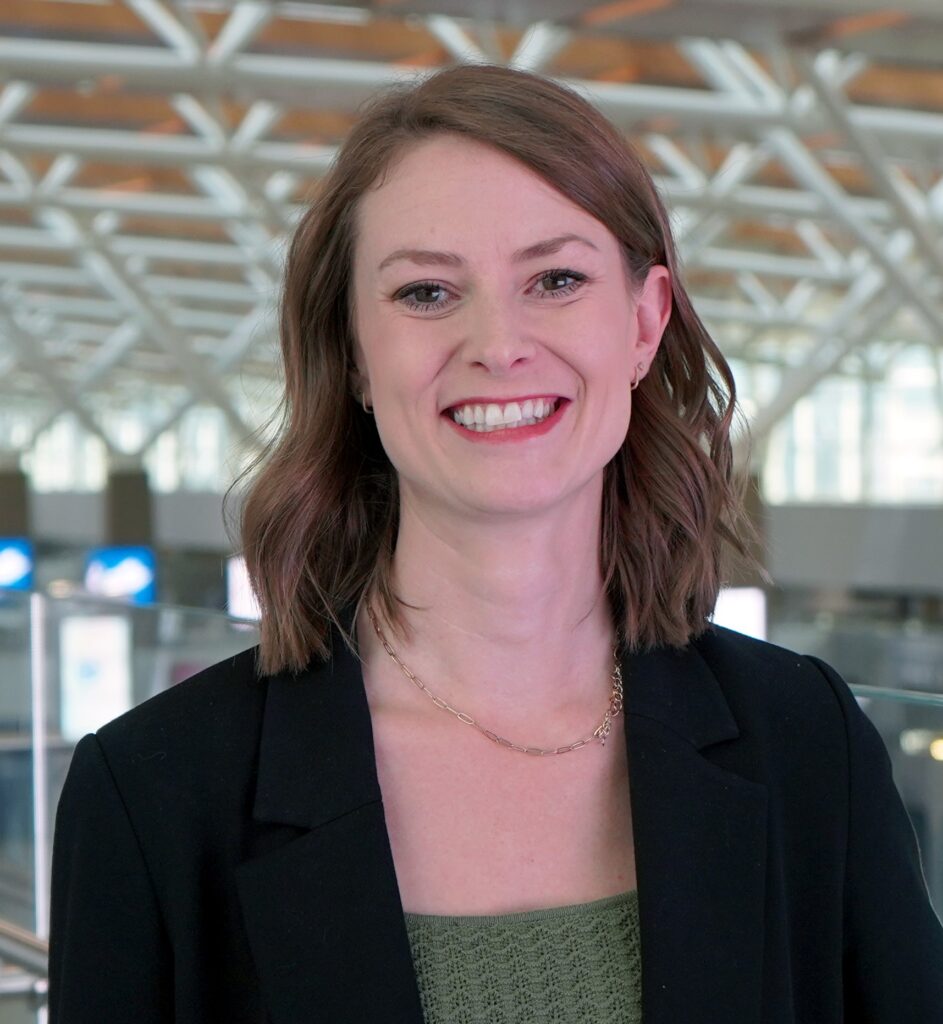
PTT sits down with Caitlin Thomas, accessibility programs coordinator at Calgary Airports, to discover more about the expert insights she plans to share in the panel discussion – titled ‘Operationalizing accessibility: bridging the gap between strategy and frontline teams’ – at Passenger Terminal Conference 2026 (March 17, 18 & 19) in London, UK.
What have been the biggest challenges in translating accessibility strategy into practical, frontline actions at the airport?
One of the biggest challenges in translating strategy into practical, frontline actions is recognizing accessibility as a hidden operational risk. Too often, accessibility work becomes emotional labor rather than embedded organizational practice. This is largely because accessibility is not yet operationalized with the same systems and rigor as safety, security or sustainability. Adopting a quality-system approach, supported by practical tools, creates governance and consistency. It also reduces dependence on individual moral effort and enables an environment where dignity can be delivered reliably in daily operations.
How has the use of plain language guidance helped increase understanding of technical accessibility standards among staff?
Accessibility standards and regulations are often complex, technical and written for specialists. Without translation, regulatory intent can remain disconnected from real-world action. This is where plain language becomes essential; it bridges technical requirements with human experience, turning dense rules into practical, usable direction.
By pairing simplified explanations with step-by-step tools tied directly to regulatory clauses, plain language guidance can show teams not only what rules apply, but how to meet them consistently.
What insights have emerged from your accessibility quality assurance program, and how have these informed operational improvements?
The Accessibility Quality Assurance Program (A-QAP) is in active development, and will be guided through our Accessibility Management Manual (AMM). Even in its early phases, several elements already exist at our airport, such as real-time reporting of accessibility service impacts, operational escalation pathways and plain language guidance. These are scalable foundations soon to be unified under a formal, quality program.
A key learning throughout the development of the AMM has been the importance of shifting from a disability-first lens to a barrier-first lens. Rather than asking, ‘what does someone with this type of disability need?’ we focus on, ‘what barriers exist here, and for whom?’ This reframing moves the discussion away from individual diagnoses and toward universal human needs.
How do you maintain a continuous improvement loop to ensure accessibility initiatives evolve alongside passenger needs?
Together, the AMM and A-QAP establish clear governance, quality objectives, risk-based decision-making and root-cause analysis. The system is designed to identify potential non-conformances to accessibility regulations early. It also integrates barrier identification assessments to help us understand how various passenger needs function as part of a broader ecosystem, rather than as isolated issues. Critically, lived-experience perspectives will remain integrated as an ongoing component of the A-QAP to ensure initiatives evolve alongside passenger needs.
What is the key message you would like delegates to take away from your presentation – and who are you particularly hoping to connect with at the conference?
Regulation alone does not operationalize dignity. Regulations set expectations, but they do not build the organizational muscle required to meet them. Many regulatory frameworks illustrate a recognized challenge; they mandate outputs without defining the structured inputs needed to achieve those outcomes. While outputs matter, legislation rarely prescribes a standardized system for identifying barriers, assessing risk, integrating accessibility into capital planning, or monitoring performance over time. Regulations set the destination, but it’s organizations that must build the vehicle to get there – systems that carry accessibility beyond compliance and into lived experience.
At Calgary Airports, we see accessibility as a function of the entire airport ecosystem. That’s why I am looking forward to a wide-variety of topics and presentations, particularly to understand how others are creating solutions through a barrier-first, human-centric lens.
To hear more valuable industry insights from top aviation executives, book a conference pass for Passenger Terminal Conference, taking place on March 17, 18 & 19 in London, UK.