
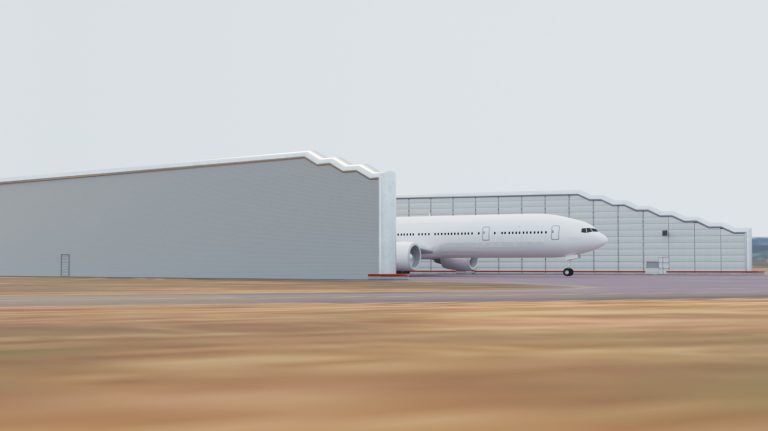
Foundation work has started on a new ground run-up enclosure (GRE) at Brussels Airport that is designed to reduce noise from aircraft engine testing after maintenance. The facility is set to be completed by the end of March 2027.
The U-shaped structure will feature noise barriers measuring 15m in height to shield the surrounding area from excess noise. Depending on aircraft type and distance from the site, the barriers are expected to cut noise by 10dB – a reduction that is perceived as making sound half as loud. Local residents in Humelgem and Steenokkerzeel are expected to see the biggest improvement.
Arnaud Feist, Brussels Airport CEO, said, “Engine run-up tests after maintenance are essential for aviation safety. With this investment, we are combining that safety requirement with a concrete reduction in noise nuisance for residents in our immediate vicinity. This new engine testing facility is just one initiative in our broader effort to create a more sustainable and quieter airport.”
The GRE is being built on a tarmac area where several outdated buildings have been demolished. The site will cover 8,000m2 – slightly larger than a soccer pitch – enabling it to accommodate larger aircraft such as the Airbus A350 or Boeing 787. Foundation works began this week, with paving to follow and noise barriers erected as a final step. The total investment amounts to more than €15m (US$17.3m).
Engine run-up testing at full power following maintenance is a safety procedure required by regulation. Previously conducted in open space, testing will now take place within an enclosure. Between 150 and 200 run-up tests are carried out each year, restricted to daytime hours (7am to 10pm) to limit noise disruption at night.
Brussels Airport said the construction work will have no impact on airport operations.
Recent news, Farrans appointed to construct new London Stansted skylinks