
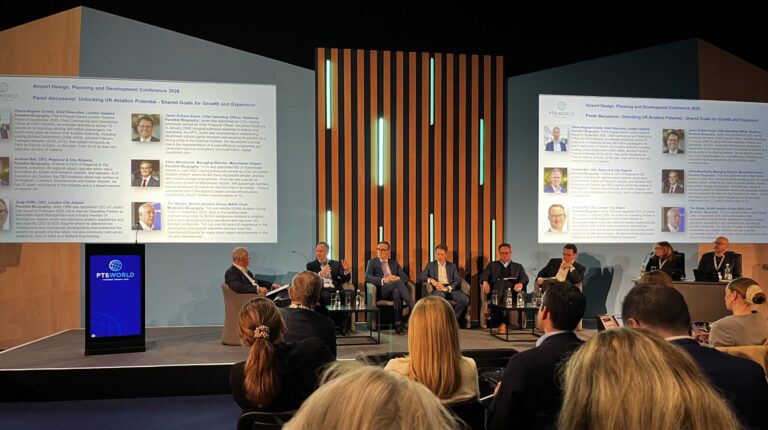
UK aviation leaders gathered at PTE World Conference & Expo today to discuss key challenges facing the sector, and opportunities for growth.
Moderated by Tim Walder, chair of the British Aviation Group, the discussion titled ‘Unlocking UK aviation potential – shared goals for growth and expansion’ featured panelists Andrew Bell, CEO of Regional & City Airports UK; Andy Cliffe, CEO of London City Airport; Chris Woodroofe, managing director of Manchester Airport; Pierre-Hugues Schmit, chief executive of London Gatwick; and Javier Echave Espot, chief operating officer at London Heathrow.
In his opening remarks, Walder highlighted the growth of the UK aviation sector, with an increase in passenger volume from 295 million in 2024 to 320 million in 2025. He referred to the aviation sector as a “critical enabler” for the UK economy, and identified “capacity, sustainability targets, regulation, workforce shortages, geopolitical risk and infrastructure challenges” as key headwinds challenging the growth of the industry.
Schmit said that growth did not just mean capacity, but also demand: “We compete not just against each other, but against other transport modes and destinations, and so we are extremely focused on delivering an affordable airport.”
He highlighted the recent planning permission approval for Gatwick’s second runway, stating, “Our growth scheme – involving the second runway – is precisely directed at growing in a savvy way to support affordable aviation for the future.”
The biggest limitation, he said, are the UK economic conditions. While he thanked the UK government for its support in building the second runway, he highlighted that the fiscal environment – such as passenger duties – makes it more difficult for airports to invest. “The UK must be business friendly, as it has been historically,” he said.
Sustainability was a key topic. The panelists agreed on the importance of setting ambitious targets, acknowledging not only the importance for the environment but also for the business case.
Espot acknowledged that the aviation sector has a duty to think of future generations, commenting, “Aviation is not the enemy – but our externalities are.” He added that growth and sustainability did not necessarily have to be competing objectives, but sustainability did have to be “embedded and incentivized.”
Woodroofe added that with advances in technology, net zero targets are becoming more achievable. “We do have a pathway to Net Zero 2050; it does involve lots of sustainable aviation fuel, carbon capture and new aircraft. The key is to stick to the path – you have to keep going, because every year that you don’t make progress creates a bigger mountain to climb.”
The PTE World Conference continues until 19 March. Click here to purchase your delegate pass