
Aurrigo International has been awarded £1.43m (US$1.93m) in UK government funding to investigate how autonomous vehicles can be used to make airports safer.
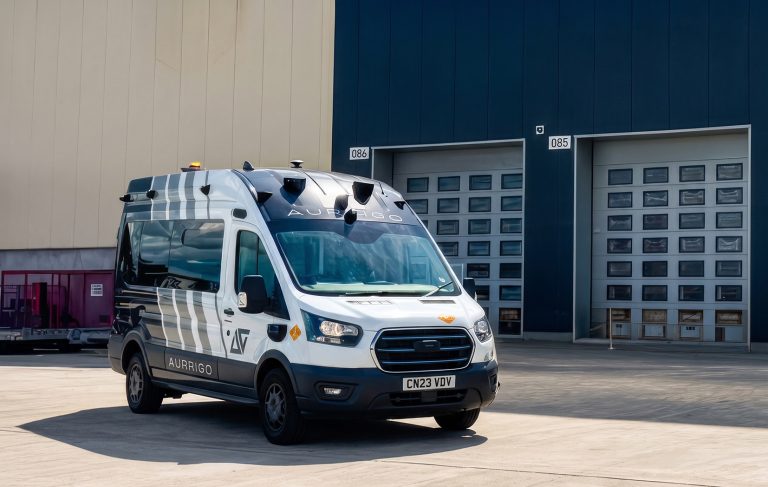
The company, which moved into its new Advanced Engineering Centre in Coventry earlier this year, will use the CAM Pathfinder grant to deploy its Auto-Shuttle vehicles to complete routine tasks including security patrols, perimeter inspections, and bird detection and deterrence. The vehicles will also be used to inspect runway and taxiway surfaces for cracks, wear or loose objects that could damage aircraft.
The project, named SENTRY, draws on the expertise of the Warwick Manufacturing Group at Warwick University, guidance from the Civil Aviation Authority, and access to a specialist testbed facility near Teesside International Airport.
“Airports are busier and more hazardous than most passengers ever realize,” said Simon Brewerton, chief technology officer at Aurrigo International. “Away from the terminal, staff spend their days walking and driving around parked aircraft, along taxiways and up and down runways, checking for loose debris, chasing away birds, patrolling for security and inspecting the roadways for damage. Much of this work happens in the dark, in wind and rain, and always with aircraft moving nearby.
“SENTRY will investigate whether some of that work could be done by small autonomous vehicles that will navigate on their own, following a set of rules agreed in advance with air traffic control. Working with our partners, we are developing the technology and building it into our Auto-Shuttle, which will first be deployed in controlled environments before operating in real airport conditions at Teesside International Airport and at Cincinnati in North America.”
SENTRY builds on Aurrigo International’s presence in the aviation sector, with the company’s Auto-DollyTug and Auto-Cargo vehicles already in use at eight airports around the world.
“Our team will measure the changes the autonomous vehicles make, including staff time savings, how quickly issues were spotted and the effect on reducing emissions,” Brewerton said. “The findings will be written up in a public report that will be shared with airports, regulators and the wider sector, providing a best-practice use case for adopting more autonomous vehicles. Aurrigo’s technology is not about replacing people – it is about taking the cold, repetitive, three-in-the-morning jobs off the roster. It will free up experienced staff for the work that genuinely needs human judgment and gives airports a practical way to raise their safety standards.”
SENTRY, which starts in September, is part of the UK government’s £150m (US$203m) CAM Pathfinder program, delivered by the Department for Business, Innovation, Science and Trade in partnership with Zenzic and Innovate UK. All UK government grant funding is subject to HMG approval.
“Today’s announcement builds on the fantastic progress made by CAM Pathfinder so far and puts the UK firmly in the driving seat when it comes to developing and deploying the CAM solutions of tomorrow,” said Mark Cracknell, program director at Zenzic.
Related news, Changi rolls out autonomous wheelchairs for passengers with reduced mobility