
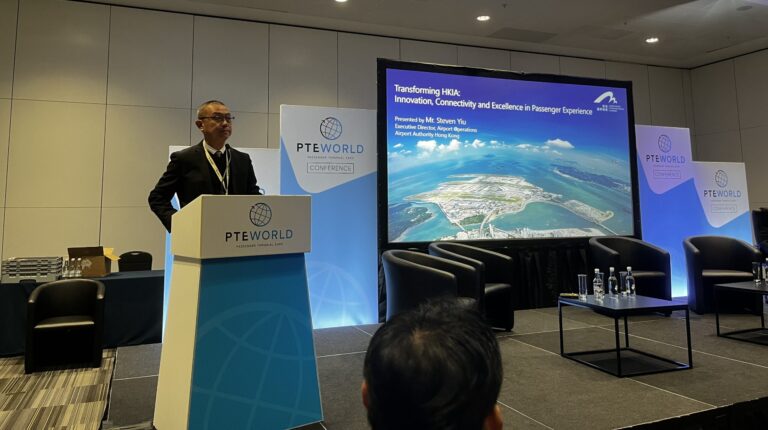
Steven Yiu, executive director of airport operations at Airport Authority Hong Kong, delivered a presentation at the PTE World Conference in London today, detailing the challenges and opportunities facing the airport.
In the presentation titled, ‘Transforming HKIA: innovation, seamlessness and excellence in passenger experience,’ Yiu outlined the three key challenges facing the airport, and how it is overcoming each one to boost regional competitiveness and the passenger experience.
The first challenge is the high cost of living in the region, with high rental prices pushing up staff wages. “We have to do something to reduce the reliance on labor,” he said. One measure is HKIA’s fleet of autonomous vehicles, which currently numbers 70, with plans to increase to 100 by the end of the year and 200 “in the next few years.”
Yiu talked about HKIA’s autonomous patrol cars, which operate 24/7. “We are the first airport that has fully integrated autonomous vehicles into our real-time operations,” he said. Featuring AI sensors, the patrol cars are designed to stop automatically if they detect any irregularities, such as signs of damage to the fences on the perimeter.
The second challenge is rising regional competitiveness, particularly from the nearby Guangzhou and Shenzhen International airports, which also serve the Greater Bay Area.
To address this, HKIA is expanding its connectivity. Yiu explained, ‘Our objective is very simple: make it very easy for people to access the airport.” Describing the airport as a “multimodal transport hub,” he detailed the “sea-to-air” ferry links from nine ports, the extensive bus network and the new autonomous transportation system set to launch by the end of this year. Connecting the Airport Island, Hong Kong Port and the nearby town of Tung Chung, Yiu reported that the latter will be capable of carrying 5,000 passenger per hour.
He also highlighted the 1,500-capacity, 24/7 fully automated parking garage inside the restricted area. Passengers have their passports and boarding passes checked before entering, and can leave their cars in a kiosk to be automatically parked via robotics.
The final challenge is rising passenger experience expectations. HKIA has a high volume of business travelers – around 11 million per annum. “They have higher expectations,” Yiu noted, “and we must meet their expectations of operational efficiency and seamless travel.”
Using customer journey mapping, HKIA identified baggage check as an uncertainty for business travelers. To address this, it launched a home baggage collection service. Via a paid-for package, contractors arrive at the passenger’s hotel or office and collect luggage the day before travel.
HKIA has also introduced Flight Token to streamline the travel experience. The self-service biometric identification system enables passengers to pass through various departure checkpoints – from bag drop to security checks and boarding – by simply showing their faces, and without having to present their travel documents and boarding passes.
Finally, he reported, the introduction of 3D, 360° CT security scanners has increased throughput per lane by 50%, increasing the number of passengers processed per hour from 240 to 360. “It improves not only the passenger experience but also operational efficiency,” he said.
The PTE World exhibition and conference continue tomorrow. Click here to purchase a conference delegate pass and here to register for a FREE expo pass