
In the April issue of PT World, we take a look at Houston’s West Concourse expansion, which is designed to add capacity, reduce stress and preserve the airport’s hallmark ‘quick-in, quick-out’ experience
Work continues on a major expansion at William P. Hobby Airport (HOU) in Houston, Texas, where a new West Concourse gate addition and baggage handling system are being delivered to support rising passenger demand and improve the arrival experience. With Corgan serving as prime architect and interior designer, construction began in April 2024 and is expected to be completed in the second quarter of 2027. The project team includes Southwest Airlines, Hensel Phelps and Houston Airports.
At the heart of the US$470m development is a straightforward ambition: to create more space and smoother flows without losing the convenience that has long defined Hobby. The project will increase the number of gates, overhaul baggage operations and rethink how passengers move from aircraft to curb.
“Designed to support sustained passenger growth, the West Concourse expansion at William P. Hobby Airport simplifies passenger flows, adding seven new gates [six domestic and one international], and easing congestion in the baggage claim hall,” says Jonathan Massey, managing principal and aviation sector leader at Corgan. “Upgrades, including a new baggage handling system, improve post-arrival flow and support near- and mid-term passenger growth while preserving Hobby’s ‘quick-in, quick-out’ experience during peak periods.”
From the curbside canopy and outdoor plaza to the baggage claim hall, the expansion is intended to make every step faster and less congested.
Mapping each step
Corgan’s research and innovation team, Hugo, carried out extensive passenger journey mapping by observing and interviewing travelers at various points from arrival gate to curbside pickup. Those insights were then used to build profiles reflecting different user groups, including business, leisure and family passengers. Airport staff were also consulted to understand operational inefficiencies.
“Passenger journey mapping revealed that one of the biggest pain points was congestion in the baggage claim hall – a low-ceilinged, constrained space located beneath an active roadway,” notes Massey. “All arriving passengers – regardless of whether they had checked luggage – were forced to pass through this crowded area.”
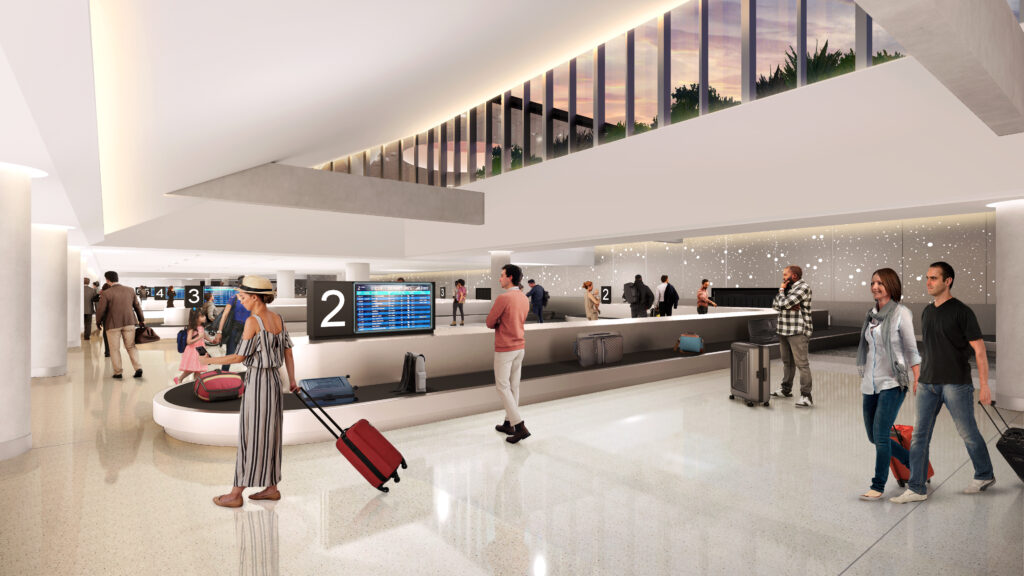
The terminal expansion creates a more legible post-arrival route. “Our redesigned flow introduces a clear decision point after deplaning: passengers with checked bags are guided toward baggage claim, but those without checked bags can proceed directly to the exit and ground transportation,” says Massey. “Architectural cues – including non-rectangular volumes, ceiling geometry and natural light – guide movement intuitively, reducing reliance on signage and lowering stress for travelers.”
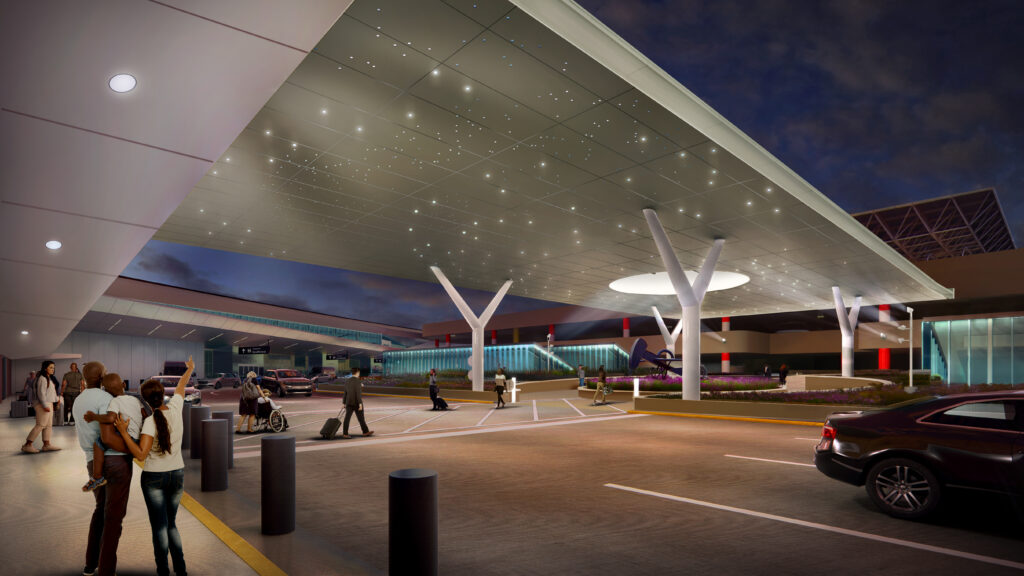
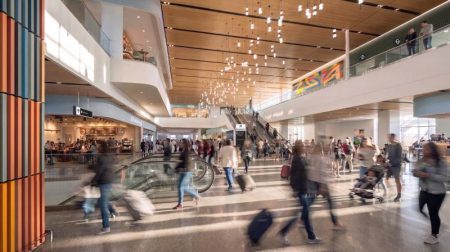
As in many of the world’s busiest terminals, wayfinding at HOU is not just about signs but about spatial understanding. The design team has sought to use form, volume and light to help passengers instinctively know where to go. In the baggage claim hall itself, updates include an art feature wall and a more open ceiling to bring in significantly more natural light. The aim is to transform what was once a compressed, purely functional area into a more welcoming and navigable space.
More gates, greater flexibility
While the baggage and arrivals improvements are among the most visible passenger benefits, the gate expansion is equally important from an operational perspective. The seven additional gates will help the airport accommodate continued growth and provide greater flexibility for aircraft movements and passenger processing.
One of those gates will handle international operations, giving the airport new options for future route development. Massey notes that although the immediate function is to support flexibility within the West Concourse, the inclusion of an international gate is also a strategic move. “The inclusion of one international gate expands the airport’s operational flexibility and positions the West Concourse to support future international service,” Massey says.
This added flexibility comes at a useful moment for Houston. The airport is preparing for increased traffic volumes, and is working to have parts of the development complete before the world’s attention turns to the city in June.
“All new baggage claim devices and the garage canopy will be completed by June 2026, just in time for [the FIFA] World Cup matches in Houston,” explains Massey. “New gates 11 and 12 will open ahead of the concourse expansion to enable the existing Gate 5 to be closed and final tie-in to the existing ramp and concourse levels completed.”
Those interim milestones show how carefully staged the delivery has been. Rather than waiting for one large handover at the end of the program, the team is sequencing openings and tie-ins so the airport can continue operating efficiently while work proceeds.
A smarter baggage future
Another of the project’s key components is a new baggage handling system supplied by Leonardo. “William P. Hobby Airport is investing in the future of baggage handling systems – installing the second-ever TSA checked baggage inspection system (CBIS) in the US using a crossbelt sortation system,” says Massey. “Traditional conveyor-based systems require intensive maintenance and frequent manual intervention when bags jam. By contrast, the Leonardo system uses individual cells – each carrying a single bag – that travel along a track and discharge bags precisely at their destination.”
The technology is already well established in Europe but, according to Massey, the installation at HOU will be the first in the US at this scale. For the airport, it promises reduced maintenance requirements, lower labor demands and more accurate sorting. For passengers, the benefit is more indirect but no less meaningful.
“While the technological and functional updates to the baggage handling systems will be out of view of passengers, they are expected to have a significant positive impact on wait times for those who check bags – resulting in a greatly improved experience for travelers,” says Massey.
Sustainable by design
Sustainability is part of the project story, though in a measured and practical way. Rather than emphasizing a single certification target, Hobby Airport’s West Concourse incorporates environmental performance through specific design decisions that improve comfort and reduce operational demand.
“The West Concourse incorporates sustainability through design strategies such as increased natural daylight in the baggage claim area, intuitive passenger flows that reduce congestion, and a highly efficient baggage handling system that lowers operational and maintenance demands,” says Corgan’s Jonathan Massey.
The building envelope has been designed to respond carefully to Houston’s climate. “The West Concourse glazing employs frit and translucent glass treatments to respond to daily and seasonal sun patterns,” Massey reports. “The glazing treatments maintain abundant natural light while minimizing heat gain and glare. The glazing is incorporated into a high-performance building envelope that performs 20% better than baseline code. This allows for more efficient HVAC systems and reduces the building’s use of our precious natural resources.”
Reimagining the curbside experience
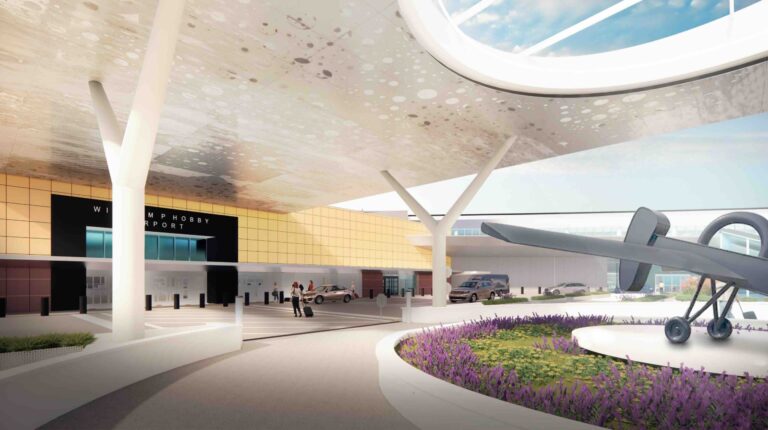
A new outdoor plaza and curbside canopy, designed to improve first and last impressions of the airport, will boost the passenger experience.
The canopy design draws on Houston’s Space City heritage. “Using computational design, the team embedded a starry-sky lighting pattern into the canopy ceiling, creating a memorable arrival and departure experience, particularly at night – a visual nod to Houston’s identity as Space City,” explains Massey.
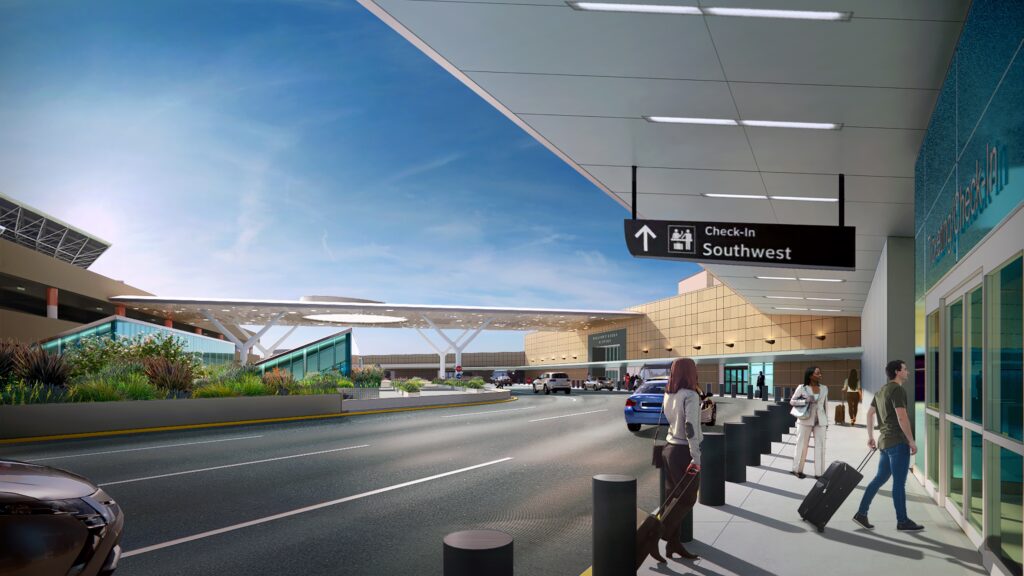
This kind of placemaking is increasingly important in terminal design, particularly at airports looking to differentiate themselves while making curbside areas easier to understand and navigate. At HOU, the adjacent plaza supports that ambition with clearer organization of traffic and pedestrian movements.
“The adjacent outdoor plaza uses seasonal planting and clear circulation to elevate the curbside experience and guide vehicles and passengers efficiently between the terminal, garage and ground transportation,” Massey notes.
The design therefore does more than provide weather protection. It uses landscape, lighting and circulation planning to improve the transition between airport and city, helping to reduce confusion in one of the most operationally intense parts of the passenger journey.
Delivering in a live environment
As with any expansion at an operating airport, one of the biggest challenges has been how to build without disrupting daily operations. The project is being delivered using a CMAR (construction manager at risk) model, with Hensel Phelps as contractor, and the phasing strategy has been critical from the beginning.
“Corgan and Hensel Phelps have collaborated on multiple airport projects, including the original West Concourse,” notes Massey. “Construction has been carefully phased, with ongoing coordination between Southwest, airport stakeholders and operations teams.”
That coordination has been supported by regular communication and stakeholder workshops, enabling the team to adjust sequencing as required. Massey points to the baggage claim hall as a good example of how this works in practice. “A new claim carousel is installed and fully operational before closing and removing an existing carousel,” he explains. “This sequence of closure and replacement micro-phases allows for continuous operation without disruptions to capacity.”
This incremental approach reflects the broader philosophy of the project. Even while introducing major new infrastructure, the team has remained focused on preserving the smooth, practical operation that passengers expect at Hobby.
This article was first published in the April 2026 issue of PT World. Click here to read the original version, and click here to subscribe to receive future issues.