
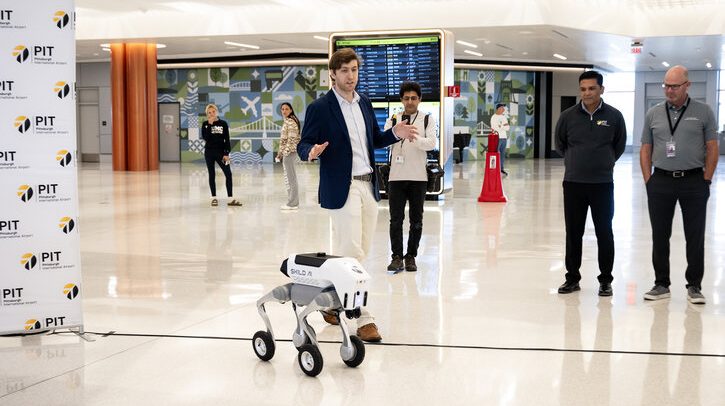
As part of its ongoing xBridge innovation program, Pittsburgh International Airport (PIT) is trialing the use of four-legged robots in the Airside Terminal to support operations including monitoring indoor air quality and detecting spills and full trash cans.
Powered by Skild AI’s adaptive autonomy software, the robots are being evaluated for their ability to navigate complex airport environments and assist airport operations. Equipped with advanced sensors, cameras and AI-driven perception, the robots can roam autonomously, detect anomalies and provide real-time data to operations staff.
Up to four autonomous robots and two charging stations will be deployed across the Airside Terminal, each with their own defined area and keep-out zones. Skild AI will conduct the installation, mapping, supervision and monitoring and will also provide on-site training to PIT staff.
“Pittsburgh is a global leader in robotics and AI,” said Deepak Nayyar, executive vice president and chief technology officer at PIT. “Through xBridge, we’re creating a place where that innovation can move from the lab into the airport environment and ultimately help shape the future of the industry. We’re looking at how the latest technology can work alongside our staff and airline partners to enhance efficiency, improve operations and provide an additional level of customer service.”
The six-month project will progress through multiple phases, allowing PIT and Skild AI to evaluate the technology across a range of airport functions.
“As a Pittsburgh company, we’re proud to partner with xBridge to make Pittsburgh International a pioneer in airport robotics,” said Sara Ahmadi, head of product at Skild AI. “We share the belief that robots will transform how public infrastructure operates, and we’re grateful for the confidence they’ve put in Skild and the energy they bring to making that happen.”
The project will also evaluate the potential for autonomous delivery, including food and beverages, to select locations within PIT’s airside terminal. If successful, autonomous delivery could also support employees by handling routine point-to-point transportation of items, allowing staff to remain focused on passengers and core operational responsibilities.
Detecting carry-on baggage
As part of a separate xBridge project, Arrow Analytics, in partnership with Southwest Airlines, is testing its EZ-Board technology in an active terminal environment to explore how the system can improve the boarding process and give airline teams better real-time information on how full overhead bin space is on the flight before a passenger boards.
Airlines closely monitor boarding times because even a few minutes can affect aircraft schedules across an entire network. When overhead space becomes constrained, airlines may ask passengers to gate-check carry-on bags. PIT, Southwest Airlines and Arrow Analytics are exploring whether new technology can provide an even more precise, real-time view of carry-on baggage during boarding.
Arrow Analytics has developed EZ Board, an autonomous system that uses off-the-shelf depth cameras and real-time analytics to identify how carry-on bags move through the boarding process. The technology, installed at Gate A7 at PIT, gives airline gate agents and operations teams a real-time picture of baggage volume, while also helping predict how much overhead bin capacity will be needed.
“We are excited to work with the innovative team at PIT as we continue to develop our EZ Board product and computer vision offerings for airports and airlines,” said Valerie McNeill, chief operating officer of Arrow Analytics.
Providing airline employees with better information about actual baggage volume and projected bin usage could increase boarding speed, reduce uncertainty and support more consistent, data-driven decisions.
Related news: Gatwick becomes first UK airport to launch robotic parking (video)