
RSHP has unveiled the design for a new terminal at Mohammed V Airport in Casablanca, Morocco, scheduled to open by 2029 ahead of the 2030 FIFA World Cup. It was made in collaboration with ALA Concept and Egis.
The project, led by Morocco’s National Office of Airports (ONDA), will deliver a terminal with an initial capacity of 20 million passengers per year. The development represents an investment of 12 billion dirhams (US$1.2bn) and forms part of the country’s wider Airports 2030 strategy.
The new terminal has been designed in an ‘H’ configuration to support hub operations, with a focus on connection times, baggage handling efficiency and aircraft access. It is also intended to accommodate future air traffic growth and support expansion plans by Royal Air Maroc.
A key feature of the project is its integration with Morocco’s high-speed rail network, linking Kenitra to Marrakech. The connection is intended to improve access between the airport and major cities, supporting multimodal transportation and reducing travel times for passengers.
The wider infrastructure includes a new 3,700m parallel runway, associated taxiways, aircraft stands and a new control tower.
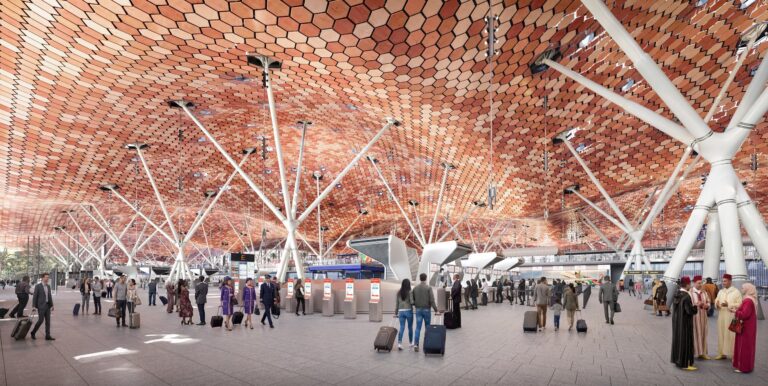
The terminal will span three levels and include retail areas, duty-free space, lounges and an airport hotel. The design incorporates landscaped areas described as “green oases”, alongside large open spaces overlooking the airfield.
Architecturally, the building design draws on Casablanca’s coastal setting, with a roof design intended to evoke Atlantic waves. Interior elements reference traditional Moroccan materials and patterns.
Construction is being delivered by a joint venture between contractors SGTM and TGCC. Preparatory works began in July 2025 and have been completed, with the first phase of the terminal scheduled for handover in 2029.
Abdou Lahlou of ALA Concept, which is working with Egis and RSHP, said, “We are honored to be designing the new terminal at Casablanca Mohammed V Airport … More than just transport infrastructure, we are offering passengers an immersive and unique travel experience.”
Ivan Harbour, senior design director at RSHP, said, “This will be a building of global importance … a state-of-the-art, responsible building that interprets and celebrates the landscape of its place.”
Stephen Barrett, director at RSHP, added that the design aims to create a distinct sense of place, avoiding “in-between spaces where a traveler can feel themselves to be both everywhere and nowhere”.
Jack Evans-Newton, associate director at RSHP, said the integration of air and rail transportation would strengthen Casablanca’s role as a gateway between Africa, Europe, and other regions.
Arnaud Cauchois of Egis said the project represents “an exciting technical challenge” and an opportunity to contribute to the modernization of Morocco’s infrastructure.
Related news, Aerodom partners with AirportLabs on digital transformation of Dominican Republic airport network