

Close Menu
Passenger Terminal TodayPassenger Terminal Today
  • News
    • A-C
      • Accessibility
      • Baggage
      • Biometrics
      • Boarding
      • Check in
      • Construction & Architecture
      • Covid-19
      • CSR
    • D-L
      • Displays & Signage
      • Expo
      • Food & Beverage
      • Ground Support
      • IT & Software
      • Lighting
      • Lounge
    • M-R
      • Operations
      • Parking
      • Passenger Experience
      • Personnel
      • Regulation & Policy
      • Retail
    • S-Z
      • Seating
      • Security
      • Self-service
      • Sustainability
      • Technology
      • Terminal
      • Wayfinding
      • Webinars
  • Opinion
  • Features
  • Online Magazines
    • April 2026
    • January 2026
    • Showcase 2026
    • September 2025
    • June 2025
    • April 2025
    • Showcase 2024
    • September 2023
    • June 2023
    • April 2023
    • January 2023
    • Archive Issues
    • Subscribe Free
  • Videos
  • Webinars
  • Supplier Spotlight
  • Events
LinkedIn Facebook X (Twitter)
  • Sign-up for Free Weekly E-Newsletter
  • Meet the Editors
  • Contact Us
  • Media Pack
LinkedIn Facebook
Subscribe
Passenger Terminal TodayPassenger Terminal Today
  • News
      • Accessibility
      • Baggage
      • Biometrics
      • Boarding
      • Check in
      • Construction & Architecture
      • Covid-19
      • CSR
      • Displays & Signage
      • Expo
      • Food & Beverage
      • Ground Support
      • IT & Software
      • Lighting
      • Lounge
      • Operations
      • Parking
      • Passenger Experience
      • Personnel
      • Regulation & Policy
      • Retail
      • Seating
      • Security
      • Self-service
      • Sustainability
      • Technology
      • Terminal
      • Wayfinding
      • Webinars
  • Opinion
  • Features
  • Online Magazines
    1. April 2026
    2. January 2026
    3. Showcase 2026
    4. September 2025
    5. June 2025
    6. April 2025
    7. January 2025
    8. Showcase 2025
    9. September 2024
    10. June 2024
    11. Subscribe Free
    Featured
    April 9, 2026

    April 2026 issue is now available online!

    Online Magazines By Web Team
    Recent

    April 2026 issue is now available online!

    April 9, 2026

    January 2026 issue is now available online!

    December 11, 2025

    Passenger Terminal World Showcase 2026

    October 28, 2025
  • Videos
  • Webinars
  • Supplier Spotlight
  • Events
LinkedIn Facebook
Subscribe
Passenger Terminal TodayPassenger Terminal Today
Opinion

OPINION: End‑to‑end baggage automation – why the handler process needs a new approach

VanderlandeBy VanderlandeMay 1, 20265 Mins Read
End‑to‑end baggage automation: why the handler process needs a new approach.

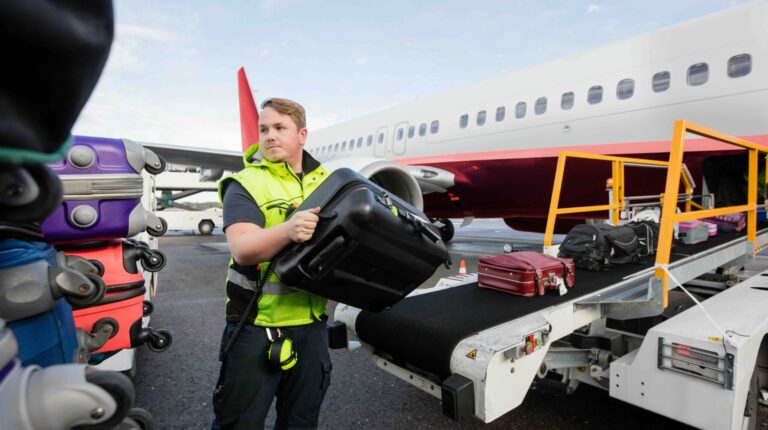
Airports across the world face mounting pressure as passenger numbers continue to rise. While much of the baggage handling system (BHS) is highly automated, the ground handling processes between the BHS and the aircraft have seen little innovation in recent decades. Ground handlers still perform some of the most physically demanding and least automated tasks, including loading departing baggage into containers and carts and unloading arriving baggage from these under tight time constraints. These manual activities are labor intensive and highly repetitive, putting pressure on and straining staff and infrastructure during peak periods. At the same time, airports often have limited space in which to expand.

Airports are increasingly recognizing the need for a new operational approach – one that provides predictable flows, reduces physical workload and improves performance across the entire baggage chain.

Smoothing baggage flow in the make-up area

In most airports, bags arrive at the make‑up area as soon as check‑in opens, occupying make‑up resources for long periods. This ‘batching’ approach results in peaks, extended make‑up opening windows and uneven workload for handlers.

To minimize peaks and optimize the handling of early check-in and transfer bags, an early bag storage system can be used. This allows bags to be stored and retrieved efficiently in batches rather than individually, and be released for make-up in a batching approach. The result is improved use of make-up resources, reduced labor cost and a flexible, scalable baggage handling framework that supports further automation.

Scalable departure automation for existing and new systems

Even though the need for automation is clear, many airports are unable to redesign their entire baggage hall. Furthermore, factors such as staffing shortages, labor costs and strict employment regulations differ from one airport to another. Solutions must be designed to be compatible with existing layouts and be scalable, upgradeable and futureproof to allow airports to introduce more advanced automation at their own pace, in line with their own needs.

Robotic loading technologies such as Bagload support current operational needs by offering multiple work cell types. Bagload is a fully automated robotic loading solution that enables safer, more efficient baggage loading. It is designed to accommodate various process configurations, either in close collaboration with operators for conventional push approaches and last‑minute builds, or as part of a batch‑driven concept for maximum productivity. As an intermediate step, semi-automated loading devices can reduce manual lifting while preserving existing workflows.
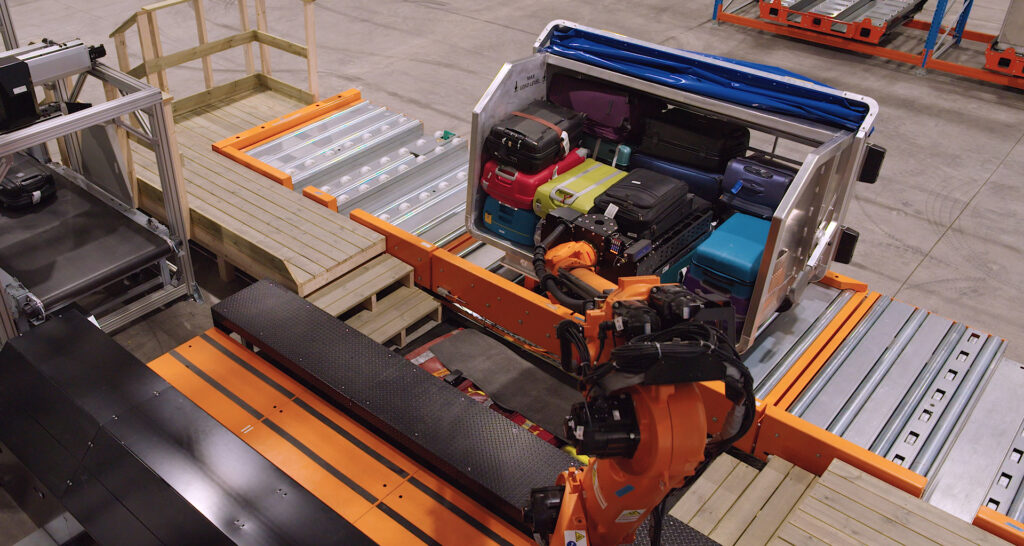
Precise robotic loading into an Airport Load Device with BAGLOAD.
Precise robotic loading into an airport load device with Bagload

Automation does not stop at loading. To enhance loading efficiency, the transportation and storage of containers can be automated using container conveyors and/or autonomous vehicles (AVs). This ensures that empty containers are available at the correct build location and time. Full containers can either be consolidated in the same storage area or brought directly to the aircraft by AVs.

To make optimal use of baggage handling assets, the process for loose-load bulk aircraft can be standardized in the same way as for containerized aircraft. Loose-load baggage can be handled using an airport load device (ALD) that remains at the airport and is compatible with the automated loading, transportation and storage solutions.

Enhancing arrival and transfer baggage handling

The baggage arrival and transfer processes face the same challenges as the departure process, and continue to be physically demanding work. The manual unloading of unit load devices (ULDs) is time critical and strenuous, and can cause delays that directly affect minimum connection times.

Solutions such as VarioTip automate the process of tilting and emptying ULDs in a controlled manner, singulating bags and feeding them into the BHS in a single step. This substantially reduces ergonomic strain and stabilizes inbound flows. Automated unloading provides a consistent throughput of up to 30 ULDs per hour, equivalent to around 1,200 bags, and is designed to be supervised by just one operator, improving both performance and handler safety. This mirrors the benefits of automated departure loading, closing the loop in an end‑to‑end automated chain.

Toward more efficient, data–driven and ergonomic operations

End‑to‑end automation transforms the role of handlers, shifting their focus from manual lifting to supervision and exception management. When combined with a batching approach, the process becomes more predictable and data driven overall. Furthermore, logistics control software coordinates the loading, unloading and management of containers end to end while tracking each bag throughout its journey.
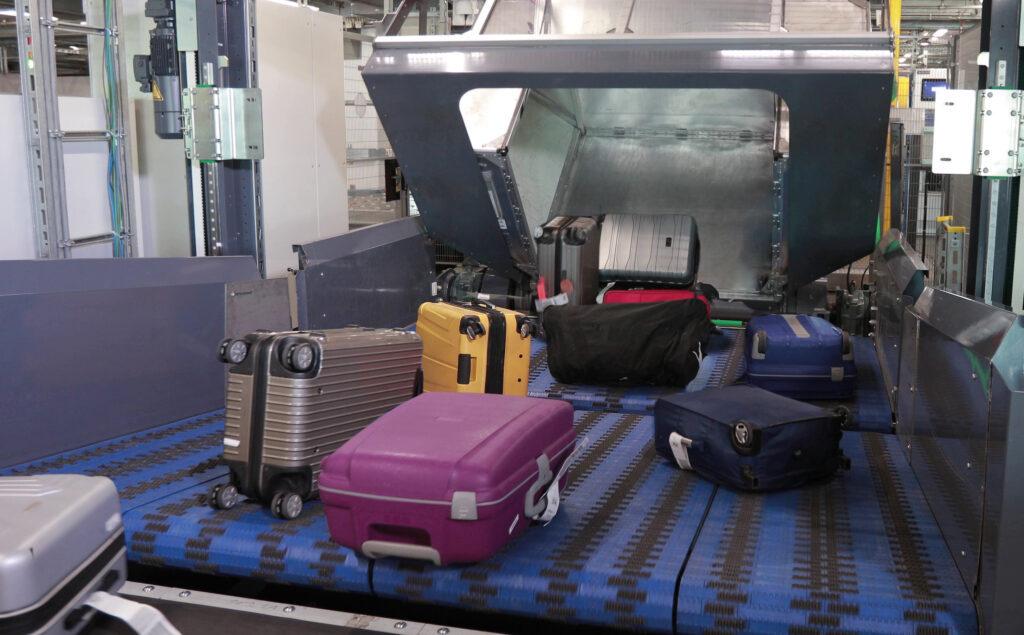
Higher baggage handling efficiency through automated ULD unloading with VarioTip..
Higher baggage handling efficiency through automated ULD unloading with VarioTip

In addition to being more efficient, the workplace becomes significantly safer and more ergonomic. By reducing physical strain, airports can better address staff shortages and create more sustainable long‑term working conditions.

Modular solutions allow airports to introduce and expand automation in phases, aligning investment with operational priorities and existing infrastructure. By combining batch‑driven processes with technologies such as Bagload and VarioTip, airports can progressively automate the handler workflow. This enables them to accommodate growing volumes within existing footprints, improve operational efficiency and establish a future‑ready foundation for resilient baggage operations.


Share. Twitter LinkedIn Facebook Email
Previous ArticleLong Beach Airport breaks ground on $37m concourse enhancement project

Related Posts

The Safety Paradox: Fewer Accidents, Greater Responsibility.
Opinion

OPINION: The safety paradox – fewer accidents, greater responsibility

April 30, 20264 Mins Read
Opinion

OPINION: Rebuilding the core of airport operations

April 16, 20264 Mins Read
Opinion

OPINION: From intent to impact – Accessibility’s hidden risk

April 1, 20266 Mins Read
Latest News
End‑to‑end baggage automation: why the handler process needs a new approach.

OPINION: End‑to‑end baggage automation – why the handler process needs a new approach

May 1, 2026
Long Beach Airport breaks ground on $37m concourse enhancement project.

Long Beach Airport breaks ground on $37m concourse enhancement project

April 30, 2026
The Safety Paradox: Fewer Accidents, Greater Responsibility.

OPINION: The safety paradox – fewer accidents, greater responsibility

April 30, 2026

Receive breaking stories and features in your inbox each week, for free


Enter your email address:


Our Social Channels
  • Facebook
  • LinkedIn
Getting in Touch
  • Sign-up for Free Weekly E-Newsletter
  • Meet the Editors
  • Contact Us
  • Media Pack
© 2026 UKi Media & Events a division of UKIP Media & Events Ltd
  • Terms and Conditions
  • Privacy Policy
  • Cookie Policy
  • Notice & Takedown Policy

Type above and press Enter to search. Press Esc to cancel.

We use cookies on our website to give you the most relevant experience by remembering your preferences and repeat visits. By clicking “Accept”, you consent to the use of ALL the cookies.
Cookie settingsACCEPT
Manage consent

Privacy Overview

This website uses cookies to improve your experience while you navigate through the website. Out of these, the cookies that are categorized as necessary are stored on your browser as they are essential for the working of basic functionalities of the website. We also use third-party cookies that help us analyze and understand how you use this website. These cookies will be stored in your browser only with your consent. You also have the option to opt-out of these cookies. But opting out of some of these cookies may affect your browsing experience.
Necessary
Always Enabled
Necessary cookies are absolutely essential for the website to function properly. These cookies ensure basic functionalities and security features of the website, anonymously.
CookieDurationDescription
cookielawinfo-checbox-analytics11 monthsThis cookie is set by GDPR Cookie Consent plugin. The cookie is used to store the user consent for the cookies in the category "Analytics".
cookielawinfo-checbox-functional11 monthsThe cookie is set by GDPR cookie consent to record the user consent for the cookies in the category "Functional".
cookielawinfo-checbox-others11 monthsThis cookie is set by GDPR Cookie Consent plugin. The cookie is used to store the user consent for the cookies in the category "Other.
cookielawinfo-checkbox-necessary11 monthsThis cookie is set by GDPR Cookie Consent plugin. The cookies is used to store the user consent for the cookies in the category "Necessary".
cookielawinfo-checkbox-performance11 monthsThis cookie is set by GDPR Cookie Consent plugin. The cookie is used to store the user consent for the cookies in the category "Performance".
viewed_cookie_policy11 monthsThe cookie is set by the GDPR Cookie Consent plugin and is used to store whether or not user has consented to the use of cookies. It does not store any personal data.
Functional
Functional cookies help to perform certain functionalities like sharing the content of the website on social media platforms, collect feedbacks, and other third-party features.
Performance
Performance cookies are used to understand and analyze the key performance indexes of the website which helps in delivering a better user experience for the visitors.
Analytics
Analytical cookies are used to understand how visitors interact with the website. These cookies help provide information on metrics the number of visitors, bounce rate, traffic source, etc.
Advertisement
Advertisement cookies are used to provide visitors with relevant ads and marketing campaigns. These cookies track visitors across websites and collect information to provide customized ads.
Others
Other uncategorized cookies are those that are being analyzed and have not been classified into a category as yet.
SAVE & ACCEPT