


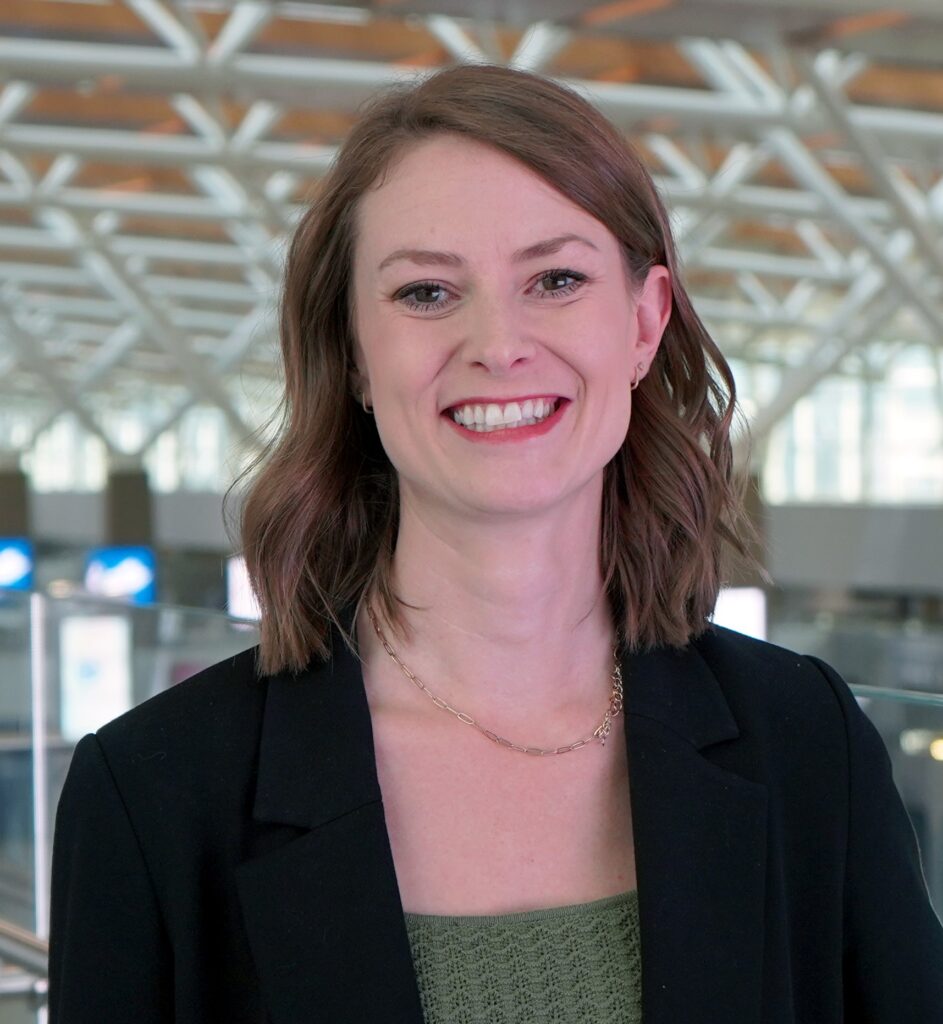
Caitlin Thomas, accessibility programs coordinator at Calgary Airports, leads initiatives that identify and remove barriers to equal access, implements innovative solutions, and facilitates meaningful dialog through the airport’s Accessibility Advisory Committee.
We will rarely hear someone say aloud “accessibility doesn’t matter’, but it’s said silently hundreds of times a day – in the way passengers with disabilities are treated as exceptions and accommodations are reactive rather than built-in. Quietly, dignity becomes something people must request.
In airports, this shows up through design choices that communicate who the terminal was built for – and who it wasn’t; through accessibility disappearing during disruptions, delays and irregular operations, precisely when it matters most; and through assistance that arrives – but only after someone has already been left behind.
Accessibility in airports is addressed with good intentions, but all too often it is addressed through isolated projects, compliance deadlines or one-time upgrades.
These efforts may satisfy regulatory requirements, but they don’t create truly inclusive environments for people with disabilities. When priorities compete, as they always do in airport ecosystems, accessibility loses ground because it’s not operationalized in the same way as safety, security or sustainability.
The core challenge is not a lack of standards, but the absence of a systematic, continuous improvement approach that embeds accessibility into airport governance and day-to-day operations rather than treating it as a box to be checked.
Change that is worthwhile often doesn’t happen quickly. It spreads slowly – through collaboration across departments, organizations and disciplines. Accessibility adds another layer – it’s deeply emotional work. When systems are absent, responsibility falls to those who care most, and over time, that produces compassion fatigue. Empathy becomes a finite resource.
If accessibility is to endure, we cannot rely on personal conviction alone. We must protect empathy with structure. Empathy, when supported by the right resources, is what produces dignity – in the way we design, build and interact with people.
Historically, robust governance has been missing in airports and other organizations. Governance helps make accessibility an operational reality rather than an exception carried by small groups of accessibility champions.
When accessibility is treated as an operational reality, it becomes integrated into how an organization plans, operates and evaluates its work. Decisions no longer rely on persuasion or passion alone. Accessibility becomes part of “how we do business”. At YYC Calgary International Airport, we knew we needed to build a system, not just deliver projects.
Intentional planning: Building the system
At YYC, the turning point came when we realized we didn’t know what we didn’t know.
Through the Airports Council International Accessibility Enhancement Accreditation process, we examined the level of our commitment to accessibility. We were honored to achieve Level 3 accreditation, but the assessment revealed several critical gaps.
We began working with experts in the field to chart a path forward, including a fulsome site review in collaboration with InterVistas, which produced several recommendations. We worked alongside them to design a ‘one-stop shop’ Accessibility Management Manual (AMM) to guide an Accessibility Quality Assurance Program (A-QAP).
The AMM is our blueprint for delivering barrier-free airport experiences. It incorporates accessibility into every aspect of our operations – from design and planning to daily guest interactions. It defines how we identify, assess and remove barriers; ensure compliance with federal regulations; and drive continuous improvement through clear roles, structured risk management, guest-focused service standards and annual quality objectives.
If regulatory requirements set the destination, the AMM is how we design the vehicle to get us there. It is the internal operating system that tells our organization how accessibility will function day-to-day.
Instinctual execution: From policy to practice
If the AMM is the blueprint, the Accessibility Quality Assurance Program (A-QAP) is the structure. It translates strategy into action through practical tools and processes to consistently identify, assess and eliminate barriers across airport operations.
Where accessibility plans and feedback processes satisfy regulatory outputs, the A-QAP supplies the missing operational inputs – turning reported issues, lived experience feedback and operational data into monitored, risk-based improvement cycles.
Together, the AMM and A-QAP establish clear governance, quality objectives, risk-based decision-making, root-cause analysis and audit and monitoring mechanisms.
They ensure accessibility is monitored, measured and improved over time – transforming accessibility from a policy commitment into an accountable, repeatable, data-informed quality system that strengthens the guest experience.
Today, the A-QAP is in active development. Even in its early phases, several elements already exist at our airport, such as real-time reporting of accessibility service impacts, operational escalation pathways and plain language guidance. These are scalable foundations, soon to be unified under a formal quality program.
An ever-evolving future
Despite much effort and real progress, we need to do more to sustain a truly inclusive future.
We must be honest about what change demands. Shifting long-standing ways of working and integrating new systems – even when we’re not reinventing the wheel – takes time. We consistently underestimate that.
Over time, the work can feel circular. Year after year, you return to the same projects, one or two tweaks, yet the same complaints resurface.
Someone wasn’t engaged early – again.
A solution introduced new barriers – again.
You re-explain, re-educate, re-advocate – again.
In that frustration, it’s easy to lose sight of an important paradox: it is within the again that change happens. Progress is built through repetition.
The risk is not repetition. The risk is concentrating that repetition on the same small group of champions. A formal system makes the “again” structural — not personal, shifting responsibility from individual moral endurance to organizational accountability.
When accessibility is not embedded into governance, responsibility falls to the individuals who care. Progress becomes fragile – dependent on personal conviction rather than organizational commitment. Decisions are triggered by emotional appeals or crisis moments. Accessibility advances when the right person is in the room – and stalls when they’re not.
Governance changes this dynamic. It shifts accessibility from something we feel compelled to do, to something the organization is equipped to deliver. In short, governance protects empathy. It ensures accessibility does not depend on who cares most, but on systems designed to deliver dignity – every time, for everyone.