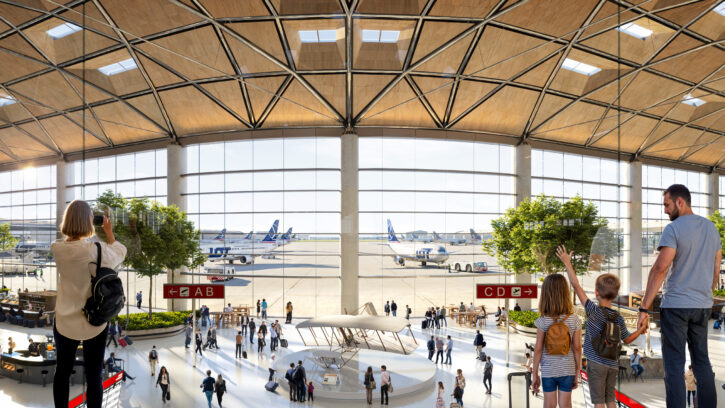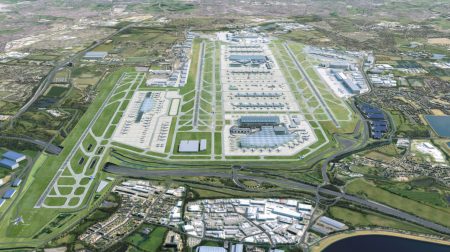

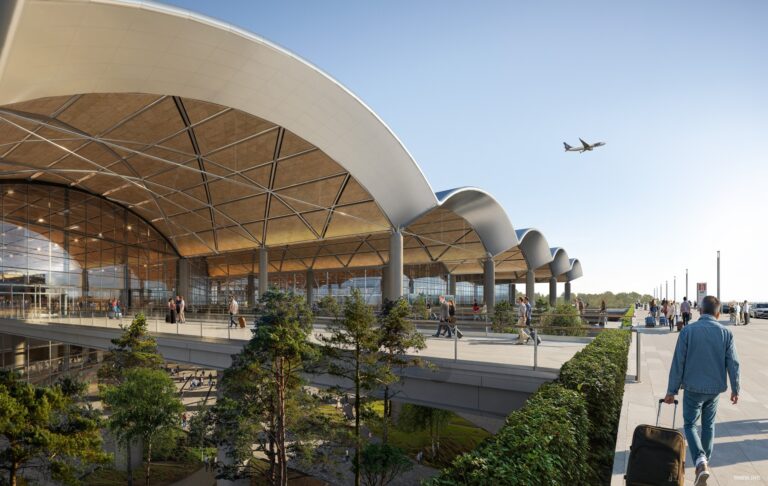
Poland’s new airport located between Warsaw and Łódź, developed under the Port Polska programme, represents a greenfield approach to integrating passenger and cargo operations within a single multimodal hub. Unlike established airports shaped over decades and constrained by surrounding development, the Polish project allows infrastructure, surface access, and operational systems to be conceived holistically from the outset. This integrated planning enables optimisation of aircraft and passenger flows while incorporating environmental and noise mitigation measures through early-stage spatial planning and land-use decisions.
For passengers, multimodality extends beyond terminal access. The airport is being designed with road, regional rail, and high-speed rail connections as fundamental elements of the system rather than ancillary links. The aim is to create a seamless journey, with transfers, check-in, security, and boarding considered as interconnected stages. Beyond the airport boundary, planning also includes onward travel and connectivity, recognising that the quality of surface access directly affects reliability and passenger experience. Coordinated capacity planning, terminal layout, and digital support are used to reduce bottlenecks and improve predictability across the network.
Air cargo operations will be integrated with the broader transport infrastructure through a combination of road, rail, and dedicated logistics facilities. A key element is Airport City, located within one to two kilometres of the airport, which hosts a Free Customs Zone. This zone is designed to support freight operations and related logistics services, including packaging, light manufacturing, and kitting. Although there will be no direct rail-air cargo intermodality, the proximity to airport infrastructure allows predictable cargo flows, while rail connections extend the reach of freight movements to regional and international destinations. Through coordinated logistics planning aligned with air transport, the project provides a platform that concentrates supply chains, enhancing scale, reliability, and overall hub attractiveness directly and beyond for air cargo operations.
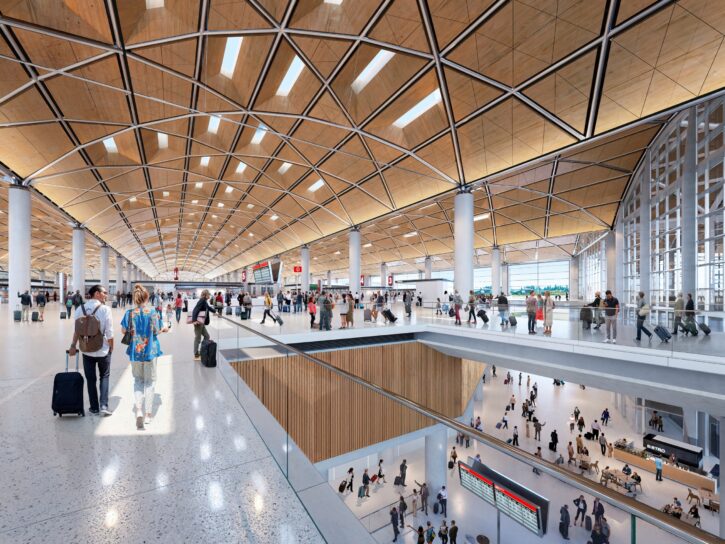
The design accommodates future operational developments. Greenfield planning allows the integration of autonomous vehicles for airside and landside operations, as well as the deployment of digital systems to manage passenger and cargo movements. The Cargo Management System, for instance, consolidates information across stakeholders, including airlines, ground handlers, freight forwarders, and border authorities, improving transparency and operational coordination. These measures are intended to increase the resilience of the airport system to fluctuations in passenger volumes, cargo demand, or transport disruptions.
The new airport illustrates how a greenfield project can incorporate multimodality into its core design, rather than retrofitting it onto existing infrastructure. The planning approach extends beyond aviation functions, linking passengers and freight to wider transport networks and surrounding urban areas. By integrating terminal operations, transport modes, and logistics facilities, the project highlights the potential for airports to act as mobility and logistics nodes, providing a framework that can adapt as travel patterns and supply chains evolve.
As aviation and logistics continue to evolve, the new Polish airport demonstrates a planning approach that prioritises system-level coordination, operational predictability, and the alignment of multiple transport modes. It provides a case study in how multimodality can be embedded into airport design from the beginning, offering lessons for both passenger experience and cargo efficiency in future developments.
* This article was written by Paweł Zagrajek, commercial deputy director, Port Polska Programme, Centralny Port Komunikacyjny