
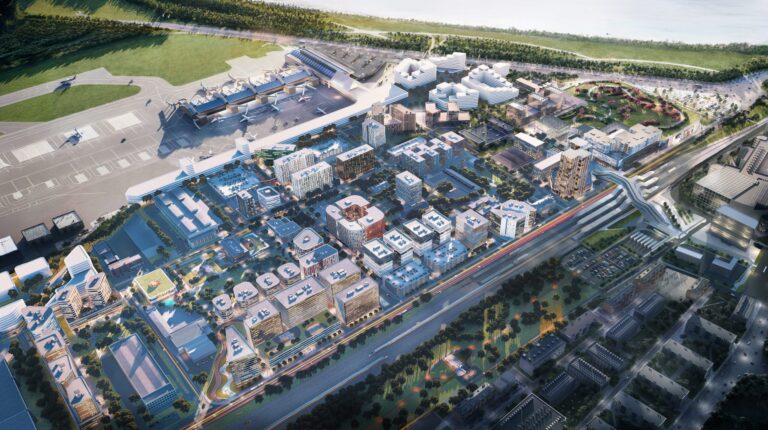
The completion of the Rail Baltica Linda Terminal in the Ülemiste district of Tallinn will help transform the area next to the airport into a “second city center” by 2030 by creating a transportation hub that will help attract international business and investment.
Tallinn Airport, Rail Baltic Estonia and Mainor Ülemiste are jointly investing nearly €500m (US$500m) in projects aimed at redeveloping the former industrial district into what they describe as a “modern urban gateway attractive to international companies and investors.”
Sten Pärnits, chairman of the management board of Mainor Ülemiste, said the Rail Baltica Linda Terminal will integrate international and local rail, trams, buses and the airport into a single transportation hub. “Together with the Rail Baltica Linda Terminal, Ülemiste Centre and Tallinn Airport, we are creating an area that is no longer merely a transport hub but a city within a city,” he said.
He added that the development is intended to attract investment and international visitors to Tallinn and Estonia, and that a planned conference facilities would help support this goal.
Ülemiste City is already Estonia’s third-largest economic district based on labor taxes, with companies generating nearly €3bn (US$3.5bn) in revenue in 2024. By 2030, around 25,000 people are expected to live, work and study in the area.
Plans include a park and a high-rise building designed by Zaha Hadid Architects that will house a 4,700m² conference center. A spa complex of up to 6,000m² and four residential buildings with 400 apartments are also planned. The conference center alone is projected to generate €140m (US$165m) in tax revenue.
Tallinn Airport expects passenger numbers to grow from 3.5 million today to up to five million by 2030 and is investing €75m (US$88.5m) in an expansion project to accommodate this. Chairman of the management board Riivo Tuvike said the expansion is needed to ensure “smooth, safe and high-quality passenger service over the next 10–15 years.”
The airport plans to introduce additional self-service technologies, including expanded baggage self-check options from the second half of 2026 and automated boarding gates at a later date. In the future, passengers traveling via Rail Baltica will be able to check in baggage at their rail departure point and have it transferred to their final destination.
Anvar Salomets, chairman of the management board of Rail Baltic Estonia, said Rail Baltica could bring around two million additional passengers to Estonia annually. The Linda Terminal at Ülemiste is scheduled for completion in 2028, with construction progressing on schedule. “By the end of this year, the building’s concrete structure will be completed,” Salomets said.
Over the next decade, up to 15 million people are expected to pass through the Ülemiste area annually across air and rail travel, as the district embraces its growing role as a major transportation and urban center.
Related news, Munich Airport’s new Terminal 1 Pier undergoes extensive trial operations ahead of April opening