
The second and final phase of the Portland International Airport (PDX) main terminal expansion has been completed. Designed by ZGF for the Port of Portland, the 90,000m2 project is the largest public infrastructure project delivered in Oregon’s history, the project partners said, completing a decade-long redevelopment of the terminal.
Since the first phase opened in 2024, the terminal has received several international honors, including the Prix Versailles World’s Most Beautiful Airport award, Fast Company’s Best Design in North America distinction, and recognition from the Holcim Foundation for Sustainable Construction.
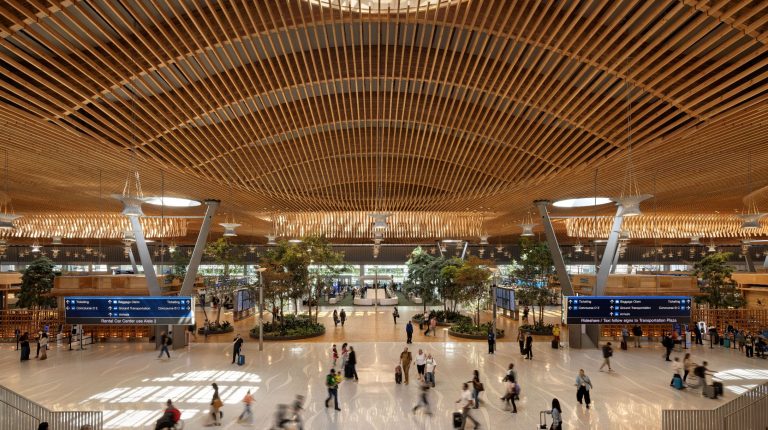
The terminal features a 3.6-hectare mass timber roof, along with views of the airfield, natural light and interior landscaping throughout the passenger journey. The newly completed second phase introduces a new arrival experience, with exit lanes on the north and south ends of the terminal streamlining concourse connections and leading arriving passengers to a new descent to baggage claim. The phase has also added expanded post-security gathering areas, skylit all-user restrooms, new local retail and dining options, and art installations.
Sharron van der Meulen, managing partner at ZGF Architects, said, “This airport is designed to meet the needs of travelers today while adapting to the demands of the future, enabling it to serve the region for decades to come. This project would not have been possible without the Port of Portland’s vision and dedication, along with the collaboration of our talented project partners.”
The US$2bn renovation and expansion is said to be the largest mass timber project of its kind. Rather than building an entirely new terminal, the Port of Portland and ZGF renovated and expanded the existing terminal in place, keeping the airport fully operational throughout five years of phased construction. The approach was enabled in part by a prefabricated wood roof spanning the entire terminal.
Curtis Robinhold, executive director of the Port of Portland, said, “Thousands of local workers brought our shared vision to life, using locally sourced materials and setting a new bar for how it should be done – resulting in an airport that couldn’t have been built anywhere else.”
The expansion doubles the terminal’s passenger capacity while achieving a 50% reduction in energy use per square foot, using an all-electric ground-source heat pump system. The design enables the terminal to withstand a 9.0 magnitude earthquake in the Cascadia Subduction Zone, the partners said.
The project team includes Hoffman Skanska Joint Venture, KPFF, Arup, PAE and Swinerton.
Related news, Budapest Airport prepares for summer peak with terminal and infrastructure upgrades