
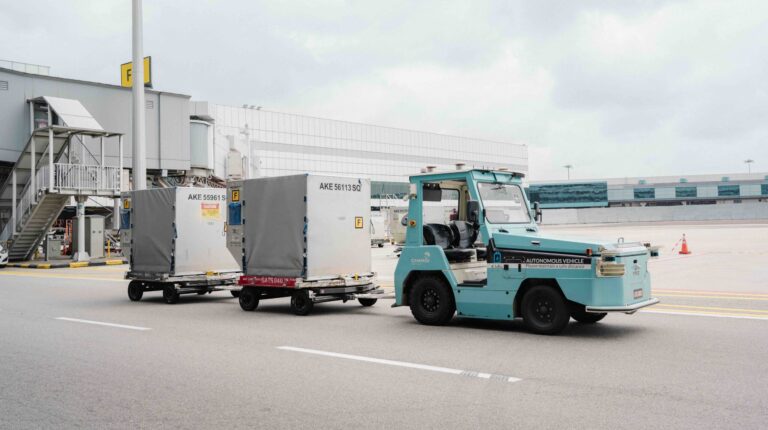
Changi Airport has begun live airside operations of fully driverless autonomous tractors, following nearly a year of trials involving more than 5,000 test trips.
Two autonomous tractors are now operating between the baggage handling areas at Terminal 1 and Terminal 4, transporting passenger bags without onboard drivers. The vehicles are equipped with more than 10 sensors and cameras, enabling them to navigate the airside environment in all weather conditions, including at night and in the rain. Operations are remotely supervised from a control center, where operators can intervene immediately if required.
The launch was officiated on January 20 by Sun Xueling, Singapore’s senior minister of state for transport, and represents a step forward in Changi Airport’s wider push toward airside automation and productivity gains.
Later this year, an additional six autonomous tractors will be introduced on a separate route between Terminal 2’s baggage handling area and aircraft stands as part of a collaboration between Changi Airport Group (CAG) and SATS. The fleet is expected to grow to 24 vehicles by 2027, with future deployments planned for towing cargo and equipment in addition to baggage.
The project is co-funded by the Civil Aviation Authority of Singapore (CAAS) and forms part of Changi’s broader innovation strategy, which includes greater use of automation, robotics and artificial intelligence in airside operations. According to CAG, the introduction of autonomous tractors is intended to free airside staff from driving tasks, enabling them to focus on last-mile activities that are more complex and harder to automate.
To support safe operations alongside human workers, designated autonomous vehicle zones have been marked on the airside, and all autonomous tractors are clearly labeled.
As Changi prepares to scale operations ahead of Terminal 5 in the mid-2030s, airport authorities say automation will play a key role in redesigning airside job roles and improving productivity.
“The operationalization of our autonomous tractors today represents a huge step forward for Changi Airport, as we move toward our vision of the airside of the future,” said Liu Yanling, senior vice president, airport operations strategy and transformation at CAG. “Through collaborating with our airport partners to redesign work processes and infrastructural policies, we are shaping a future-proofed working environment where autonomous vehicles can function safely and seamlessly with other human-driven vehicles.”
Angela Ng, director of aviation industry at CAAS, said the scaled deployment supports broader workforce transformation efforts across the aviation sector.
“The scaled deployment of autonomous tractors allows CAAS, CAG, SATS and our unions to work together to implement the technology, develop new systems and protocols, and set up job redesign programs to help our workers adopt technology and transition to higher-value work,” she said.
SATS says the initiative is expected to improve safety, turnaround efficiency and service reliability for passengers.
Related news, Menzies Aviation accelerates HVO transition at Heathrow and Gatwick