
Kaunas Airport has completed initial trials of hydrogen-powered ground vehicles, including a heavy-duty truck, as part of a European Union–funded project exploring sustainable fuel use in airport operations.
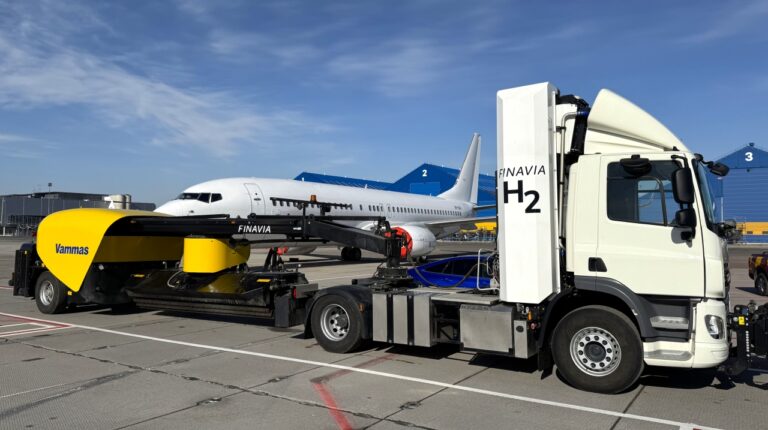
The airport tested a hydrogen-powered Hyzon truck on the apron, where it carried out routine tasks without producing CO2 emissions. The vehicle was assessed for its ability to operate across key areas including aprons, runways and taxiways, performing duties such as snow and dust removal.
The trials form part of the Interreg Baltic Sea Region BSR HyAirport project, which is also being carried out at airports in Helsinki, Finland; Riga, Latvia; and Tallinn, Estonia.
Modestas Alekna, head of sustainable aviation projects at Lithuanian Airports (LTOU), said, “Ground transport is just as important to airport operations as aircraft. We are active contributors to sustainability-driven change and have embedded green transition goals into our long-term strategy.”
He added that testing hydrogen-powered transportation “provides us with valuable experience” as the sector evaluates alternative fuels.
The 10-ton Hyzon truck was tested over several days, with a target of covering around 100km while completing standard airside maintenance tasks. Test locations were selected to avoid disruption to airport operations in the event of technical issues.
The airport said the vehicle performed reliably during the trial and was positively received by operators.
In addition to the truck, a hydrogen-powered passenger car, the Toyota Mirai, was also tested. LTOU noted that only four such vehicles are currently registered in Lithuania. The car, along with hydrogen supply and a refueling station, was provided by the Latvian Hydrogen Association, a project partner.
The organization confirmed that the hydrogen used during testing was produced using renewable energy. Alekna said, “When electricity generated from solar and wind energy is used in this process, it does not pollute the environment. In other words, such hydrogen is a versatile energy carrier that helps protect the environment.”
Kaunas Airport was selected for the trials due to its lower traffic levels and available space for testing new technologies.
LTOU has set a target of becoming a CO2-neutral organization by 2030, aligning with broader European Union plans that position hydrogen as a key component in achieving climate neutrality by 2050.
Related news, Fraport secures €2.55m in EU funding for ground power and charging infrastructure project