
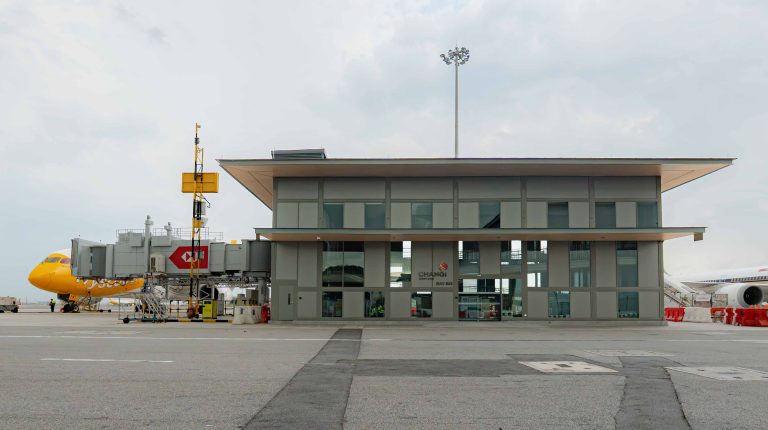
Changi Airport Group (CAG) has completed construction of its first satellite gate, a standalone remote boarding and disembarkation facility designed to improve the passenger experience for flights assigned to remote aircraft parking stands. Use of the gate for selected flights is set to begin by August 2026, with operational readiness preparations currently underway.
Located in the airfield, the satellite gate is equipped with two aerobridges, offering a fully sheltered, all-weather walkway for boarding and disembarkation. Around 98% of passenger flights at Changi currently use contact gates with aerobridges at the terminals; the remainder use remote stands, which require bussing passengers between the terminal and aircraft. CAG said remote stands are an integral part of its operating model, enabling the airport to maximize use of available apron space during peak periods.
With a floor area of 200m2, roughly the size of a tennis court, the satellite gate is designed to support both narrow and wide body aircraft. The air-conditioned building features an entrance canopy sheltering the bus bay, with a ramp leading to two aerobridges on the upper level. A gently sloping 60m ramp improves accessibility for wheelchair users, minors, seniors, families with strollers and passengers with wheeled carry-on luggage.
The facility has been designed as a zero-energy building powered entirely by rooftop solar panels, with electricity stored in a nearby off-grid battery system. It also includes smart features, including air-conditioning that activates automatically based on real-time flight information, and wireless fault detection that alerts maintenance teams at the main terminal.
Koh Ming Sue, executive vice president, engineering & development at CAG, said, “Every element of the satellite gate has been designed with passenger experience, universal accessibility, staff-friendliness and operational practicality in mind. As we continue to enhance Changi’s infrastructure, we are also integrating environmental sustainability features and smart technology into new developments to reduce carbon emissions, strengthen operational resilience and improve service efficiency.”
Since May 2026, more than 500 airport staff have taken part in training sessions and dry runs to prepare for satellite gate operations. CAG said the results from initial flights will help inform its assessment of plans for additional satellite gates, taking into account factors such as traffic demand and operational requirements.
Kia Thye Yeo, managing director, airport operations control at CAG, said remote stand facilities such as the satellite gate would play an increasingly important role in supporting operations as passenger traffic grows ahead of Terminal 5’s opening in the mid-2030s, providing “greater operational flexibility when contact gates are fully utilised.”
Related news, Changi Airport hosts Peanuts sports-themed installation